alphahands research is focused on a specific Heuer Autavia 3646 – the screwback Heuer 3646 with 1st Execution dial and 2nd Execution hands (with either a 30 minute or 45 minute recorder), produced in approximately 1962-64 (the Autavia was first introduced in 1962).
If there is one place to go in order to read all about Heuer, including history, references, production dates…the best place is OnTheDash. OnTheDash contains sections on all Heuer Autavia, but also drills into the 60s screwbacks, including the 2-register 3646.
My work started specific to the first execution dial and second execution hands with pointed lume, with either the 30 or 45 minute register, but I have also added in the 3646 thin rectangular lume 2nd execution hand.
Below is an aggregation all of the Heuer Autavia 3646 I have found with 1st Execution dial and 2nd Execution hands, with either a 30 minute or 45 minute recorder. If you see any duplicates, errors, have serial numbers to include, or know of other Heuer 3646 to add with a 1st execution dial and 2nd (or 3rd) execution hands, please let me know.
Ranges I have seen for the Heuer 3646 with 1st Execution hands and 2nd Execution dial: 48872 – 52495, corresponding to roughly 1962 – 1963. The serial number is engraved in between the lugs at 6 o’clock.
The range above is extremely limited due to few of these pieces available, and some without visible caseback images, or text, and many without serial number provided.
The watches represented on each row in the table below are intended to be unique, though given serial numbers are often not shown for images, the same watch may appear multiple times. I do my best to use visual cues to pair the same watch posted at different times. When the serial number can’t be established, I give the timepiece a unique ID (based on any part that is known, plus a related date posted).
Unfortunately, some images may not appear below as the table refers to the source page for the specific piece. If the image is removed or if the table is not able to process the site, a broken (or no) image will appear.
Caveats:
Description of pieces are generally based upon public images/video. For some detail, I do not have images and have to rely on text descriptions from the individual posting the timepiece. Some elements are often difficult to determine from pictures, including color of hands, for example if the register hands are black or blue. If I have a 50-50 guess, I leave the detail as “unknown.”
Use the filters below to search and filter the complete Heuer Autavia 3646 database. This table includes all recorded 3646 watches with comprehensive details.
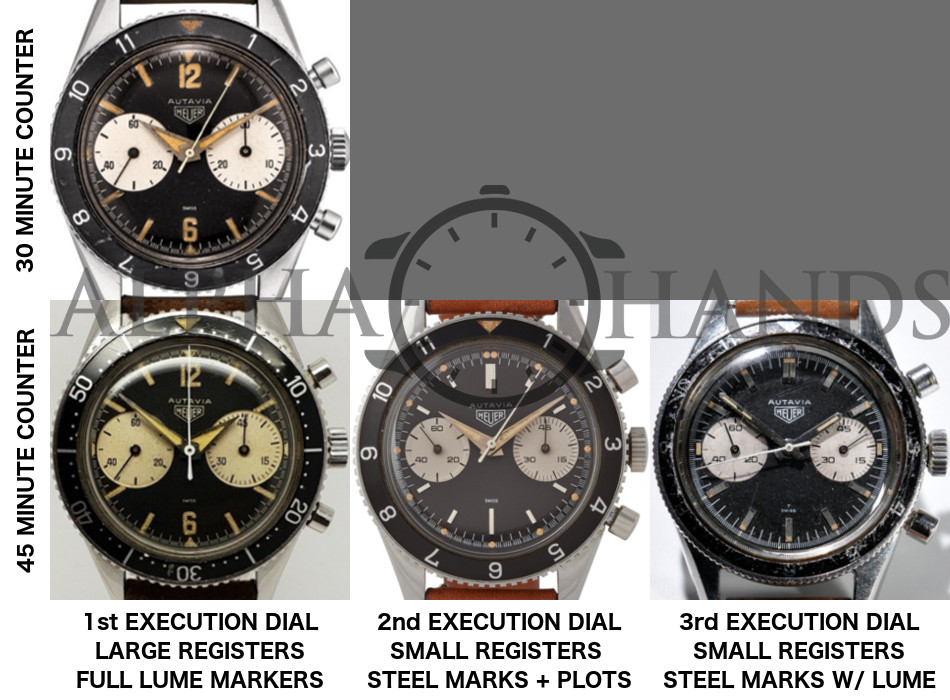
The Heuer Autavia 3646 was manufactured with three different dial variations:
Large registers, with luminous index marks and luminous 12 and 6 numerals, known as the “1st execution” dial. This dial came in both a 30 (early serials) and 45 minute counter. There is an inverted luminous triangle mark above the 12, and a luminous triangle under the 6.
Small registers, with applied steel index marks and lume plots for hours, with a thick index mark and two plots at 12. This 2nd execution dial came only with a 45 minute counter.
Small registers, with applied steel index marks and lume at the edge of the steel marker. This 3nd execution dial came only with a 45 minute counter.
Heuer 3646 Dials
We do see a couple of pieces that do not align with the rest of the 1st-3rd execution dials known:
Dial with ‘T’ in silver print above ‘SWISS’ on the lower half of the dial
Dial with ‘FAB. SUISSE’ about ‘SWISS’ on the lower half of the dial.
I do not know when this additional text was added, at time of manufacture or later, but collectors should note that these are the only pieces known with text aside from the standard “SWISS” only text at 6 o’clock.
Hour and Minute Hands
The Heuer 3646 1st execution dial was produced with three different hands:
“Full lume” dauphine hands, which are commonly known as “1st execution”
Steel edged dauphine hands filled with lume, pointed; this style is commonly known as “2nd execution”, I refer to below as “pointed lume”, and their introduction coincides with the serial numbers of the last hand style,
Same dauphine hand shape as #2, above, though with thinner lume, rectangular in shape on the hour hand, and coming to a point on the minute hand. I refer to this as “2nd execution” also as the timing for release is the same as the above, but note as “rectangular lume.’
Side note: we do see some overlap in hands, with serials for 3646 with full lume (1st execution hands) extending into the serials for 2nd execution hands.
This research is focused on the second execution hands (#2 and #3, above).
Within this set of non-full lume dauphine hands, we see an example with larger luminous area (#2) appearing on a lower serial number than the hand with thinner rectangular lume (though only one example, and a bit of an outlier). The use of the hands with thinner luminous area is limited in time (488xx-489xx), while we see the hands with larger luminous area span from 487xx-526xx.
Heuer 3646 Hand Versions on 1st Execution Dials
The hour hand of the 2nd execution hand, and we also see this on the 2446, often shows signs of rust, whereas the minute hand does not. I do not know whether this is due to the larger steel surface area of the hour hand, or due to different type of steel used.
Heuer Autavia 3646 Main Hands
Chronograph Hand
Most are familiar with the white chronograph hand of the Heuer Autavia 3646. However, we also see red chronograph hands. In cases where the Heuer Autavia 3646 has a red chronograph hand, we see the main hands featuring the thinner lume. There are cases where the hands with thinner luminous area are paired with white chronograph hands, though nearly all of those cases appear to be replacements, otherwise incorrect hands, or on watches that have been clearly restored in some way (such as relumed main hands). It is difficult to say if thin lume main hands and red chronograph hands were always paired together, but without a larger data set I would say that they were intended to pair in that manner.
We also see a single example of thin rectangular lume hand paired with a white chronograph hand that has a leaf at the end. Given I have seen just one of these to date, I am inclined to believe this is a replacement hand.